Permission
Tools & ExecutionCheck Permissions Before Execution
Dangerous actions need a harness decision point before the shell runs.
s01 → s02 → s03 → s04 → s05 → ... → s16 → s17
"Check permissions before executing" — The permission pipeline decides which operations need approval.
Harness Layer: Permission — a gate before tool execution.
The Problem
s02's Agent has 5 tools. File tools are protected by safe_path, but bash is unrestricted. Ask it to "clean up the project," and it might run rm -rf /.
Safety can't rely on trusting the model — it needs code: a check before every tool execution.
The Solution

s02's loop is fully preserved. The only change is inserting check_permission() before tool execution — each tool call passes through three gates in a fixed order: hard deny first, then soft ask, and if neither matches, allow.
The three gates correspond to three decisions:
| Gate | Purpose | On Match |
|---|---|---|
| 1. Deny List | Permanently forbidden operations (rm -rf /, sudo) | Denied immediately, not executed |
| 2. Rule Matching | Context-dependent operations (reading/writing outside workspace, rm files) | Passed to Gate 3 |
| 3. User Approval | After Gate 2 matches, pauses for user confirmation | User decides allow or deny |
None of the three gates match → execute directly. Most routine operations take this path.
How It Works
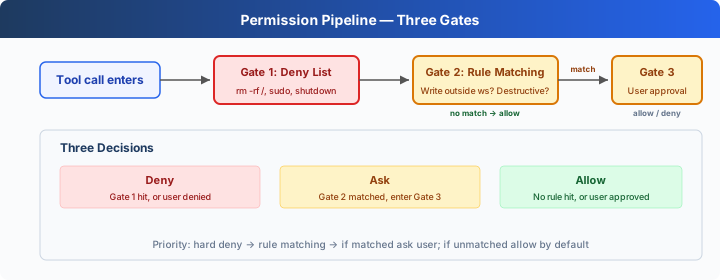
Gate 1: A hard deny list. Check first; if matched, return a block message. This list uses simple string matching to show where the permission gate sits; it is not a complete security boundary.
DENY_LIST = [
    "rm -rf /", "sudo", "shutdown", "reboot",
    "mkfs", "dd if=", "> /dev/sda",
]

def check_deny_list(command: str) -> str | None:
    for pattern in DENY_LIST:
        if pattern in command:
            return f"Blocked: '{pattern}' is on the deny list"
    return None
Gate 2: Rule matching — describes "when to ask the user." Each rule specifies a tool and a check condition.
import re

DESTRUCTIVE_COMMAND_WORD = re.compile(
    r"(?i)(?:^|[;&|()\n])\s*(?:rm|del)(?=\s|$|[;&|()])"
)

def contains_destructive_command(command: str) -> bool:
    return bool(DESTRUCTIVE_COMMAND_WORD.search(command))

PERMISSION_RULES = [
    {
        "tools": ["read_file", "write_file", "edit_file"],
        "check": lambda args: not (WORKDIR / args.get("path", "")).resolve().is_relative_to(WORKDIR),
        "message": "Access outside workspace",
    },
    {
        "tools": ["bash"],
        "check": lambda args: contains_destructive_command(args.get("command", "")) or any(
            kw in args.get("command", "") for kw in ["rm ", "> /etc/", "chmod 777"]
        ),
        "message": "Potentially destructive command",
    },
]

def check_rules(tool_name: str, args: dict) -> str | None:
    for rule in PERMISSION_RULES:
        if tool_name in rule["tools"] and rule["check"](args):
            return rule["message"]
    return None
Gate 3: After a rule matches, pause for user input.
def ask_user(tool_name: str, args: dict, reason: str) -> str:
    print(f"\n⚠  {reason}")
    print(f"   Tool: {tool_name}({args})")
    choice = input("   Allow? [y/N] ").strip().lower()
    return "allow" if choice in ("y", "yes") else "deny"
All three gates chained together, inserted before tool execution:
def check_permission(block) -> bool:
    # Gate 1: Hard deny
    if block.name == "bash":
        reason = check_deny_list(block.input.get("command", ""))
        if reason:
            print(f"\n⛔ {reason}")
            return False

    # Gate 2 + 3: Rule matching → User approval
    reason = check_rules(block.name, block.input)
    if reason:
        decision = ask_user(block.name, block.input, reason)
        if decision == "deny":
            return False

    return True

# In agent_loop — s02's loop with just one line added:
for block in tool_calls:
    if not check_permission(block):           # ← NEW
        results.append({... "content": "Permission denied."})
        continue
    output = TOOL_HANDLERS[block.name](**block.input)  # s02 original
    results.append(...)
Changes from s02
| Component | Before (s02) | After (s03) |
|---|---|---|
| Security model | None (trust the model) | Three-gate permission pipeline |
| New functions | — | check_deny_list, check_rules, ask_user, check_permission |
| Loop | Executes all tools directly | Inserts check_permission() before execution |
Try It
cd learn-claude-code
python s03_permission/code.py
Try these prompts:
Create a file called test.txt in the current directory(should pass through)Delete the file test.txt(bash + rm triggers Gate 2)What files are in the current directory?(read-only, all pass)Try to write a file to /etc/something(writing outside workspace triggers Gate 2)- On Windows,
del test.txtandDEL test.txttrigger Gate 2, whilemodel,delimiter, andecho del test.txtdo not.
What to watch for: Which operations pass through? Which need your confirmation? Which are denied outright?
What's Next
Permission checks are in place — but every check is hardcoded as check_permission() inside the loop. What if you want to add logging before and after each tool execution? What if you want to auto-trigger a git commit after certain operations? Scattering this extension logic throughout the loop makes it bloat.
→ s04 Hooks: Add hooks to the loop. Extension logic hangs on hooks; the loop stays clean.